From High Weald livestock farms around Heathfield and Crowborough to the vineyards of the Cuckmere and the equestrian country between Battle and Uckfield — agricultural roofing built to handle East Sussex farming as it actually operates.
East Sussex is properly mixed farming country. Across the High Weald between Crowborough, Heathfield and Battle you've got beef and sheep on the heavier clay, smaller arable blocks where the land allows, and a growing share of equestrian businesses — livery yards, riding schools, competition arenas. Drop south onto the South Downs around Lewes, Glynde and Alfriston and the rotation changes: bigger arable fields, big grain stores, contracting fleets working from substantial machinery sheds. And then there's the vineyard boom — the chalk slopes around the Cuckmere and the Adur are now under vine in serious acreage, and every one of those vineyards needs a packhouse with a proper roof on it.
What that means for us as roofers is variety. A week in East Sussex will see us re-roofing a Yorkshire-boarded calving shed near Heathfield on Tuesday, fitting standing-seam on an equestrian arena outside Uckfield on Wednesday, and stripping asbestos cement off a grain store at Glynde on Friday. Different specs, different access, different priorities — but all the same client problem: the roof has to keep working through the season it's needed in, and the contractor has to understand that calving, lambing, harvest and (now) harvest-and-press cannot wait.
We've been doing East Sussex agricultural work for forty years. We understand the practicalities — you can't strip a livestock barn roof in February with a hundred cows underneath, you can't block a vineyard yard during pressing week, you can't tie up a contracting fleet's machinery shed in late August. Scheduling around the agricultural calendar is half the job, and we plan for it.
Big clear-span grain stores across the South Downs arable belt — usually 25–40m span, big eaves, ridge ventilation. Insulated where moisture control matters.
Beef, sheep and the remaining dairy units across the High Weald — ridge-vent specs, Yorkshire-boarded gable infill, anti-condensation under-sheet linings for stock health.
Indoor schools and stable blocks across the Uckfield, Battle and Crowborough equestrian belt — daylit roofs with translucent panels, low-noise rainfall specs.
The fastest-growing sector in East Sussex — packhouses, press buildings and cold-store sheds on chalk-slope vineyards across the Cuckmere, the Adur and the Brede valleys.
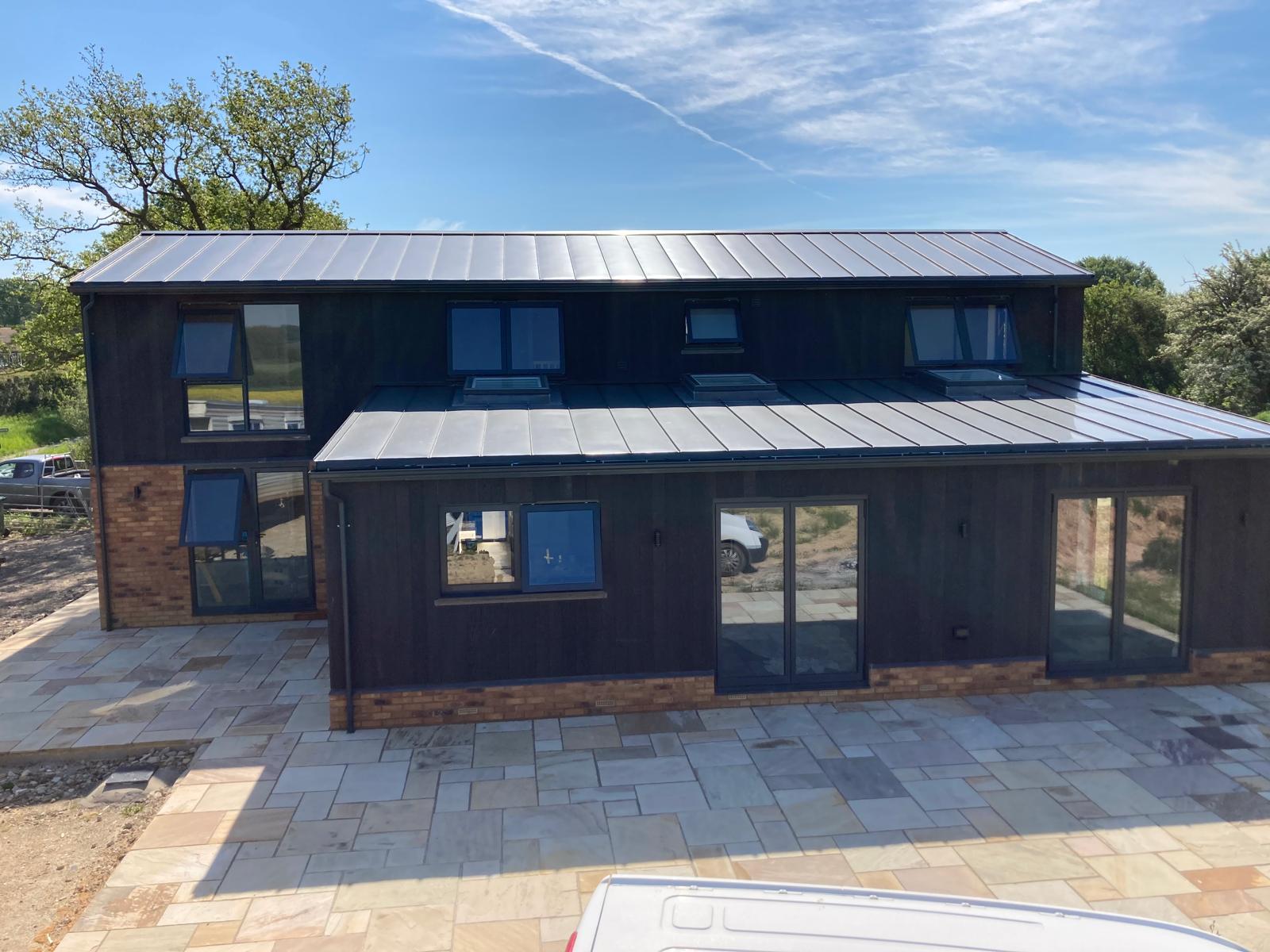
Class Q and rural-economy conversions — redundant Dutch barns becoming offices, holiday lets, wedding venues. Standing-seam, slate-effect or natural-zinc finishes for planning.
Big steel-frame sheds for the contracting fleets — combines, trailers, sprayers all under cover. Heavy-duty box profile with reinforced gutters for the run-off volume.
"New-Cladd re-roofed our main grain store at the end of August — in to start the day after combining finished, off site the day before drying needed to begin in earnest. Twenty-eight tonnes of wheat had to move into temporary storage and they did everything they could to keep that window short. I've used three different roofing contractors over the years; only one has ever actually understood how a harvest works."
Yes — this is the single biggest scheduling factor on a farm roof. We plan jobs around calving and lambing windows, around harvest and drilling, and (increasingly) around vineyard harvest-and-press in September/October. Tell us what your busy weeks are and we'll book the work outside them.
Yes — we've done several on the chalk slopes of the Cuckmere and Adur valleys. Vineyard buildings need particularly clean run-off (the press water collected from roofs sometimes ends up irrigating), insulated panels for the cold-store sections, and a sympathetic finish where the buildings sit in AONB landscape.
Yes — from the Kent border around Hawkhurst and Etchingham down to Eastbourne and the coast, and west to the Sussex/East Sussex boundary around Lewes and Newhaven. BN, southern TN and the eastern edge of RH postcodes.
Yes — we handle the asbestos in-house under the Control of Asbestos Regulations 2012, which matters because at least half the agricultural re-roof enquiries we get in East Sussex involve original 1960s-80s asbestos cement that has to come off first. Strip, dispose and re-cover as one contract.
Yes — Class Q conversions and barn-conversion roofs are a steady part of the East Sussex workload. Standing-seam zinc, slate-effect coated steel, natural-zinc finishes — whatever the planning officer has approved, we can specify and install to that finish.