The complete asbestos removal service: notifications, RAMS, removal, transport, disposal and air clearance certification — all handled in-house, all properly documented.
Asbestos cement roofs are everywhere in the South-East — warehouses, factory units, farm buildings, equestrian yards and outbuildings on commercial sites. Most were installed before 1999, most are now well into the second half of their working life, and most owners would rather not think about them until they have to.
When the time does come — whether because of a leak, a redevelopment, an insurance demand or a planned re-roof — the work has to be done by an contractor under the Control of Asbestos Regulations 2012. The notification has to be filed correctly, the operatives have to be face-fit tested and medically certified, the waste has to be tracked through the consignment system, and the clearance certificate has to come from an independent UKAS-accredited analyst.
New-Cladd runs trained operatives, owns the equipment and writes the paperwork. We work to the Control of Asbestos Regulations 2012 and notify HSE for every job under the non-licensed-work regime (ASB5). We do the asbestos strip, the disposal and the new roof — under one contract, one programme and one warranty.
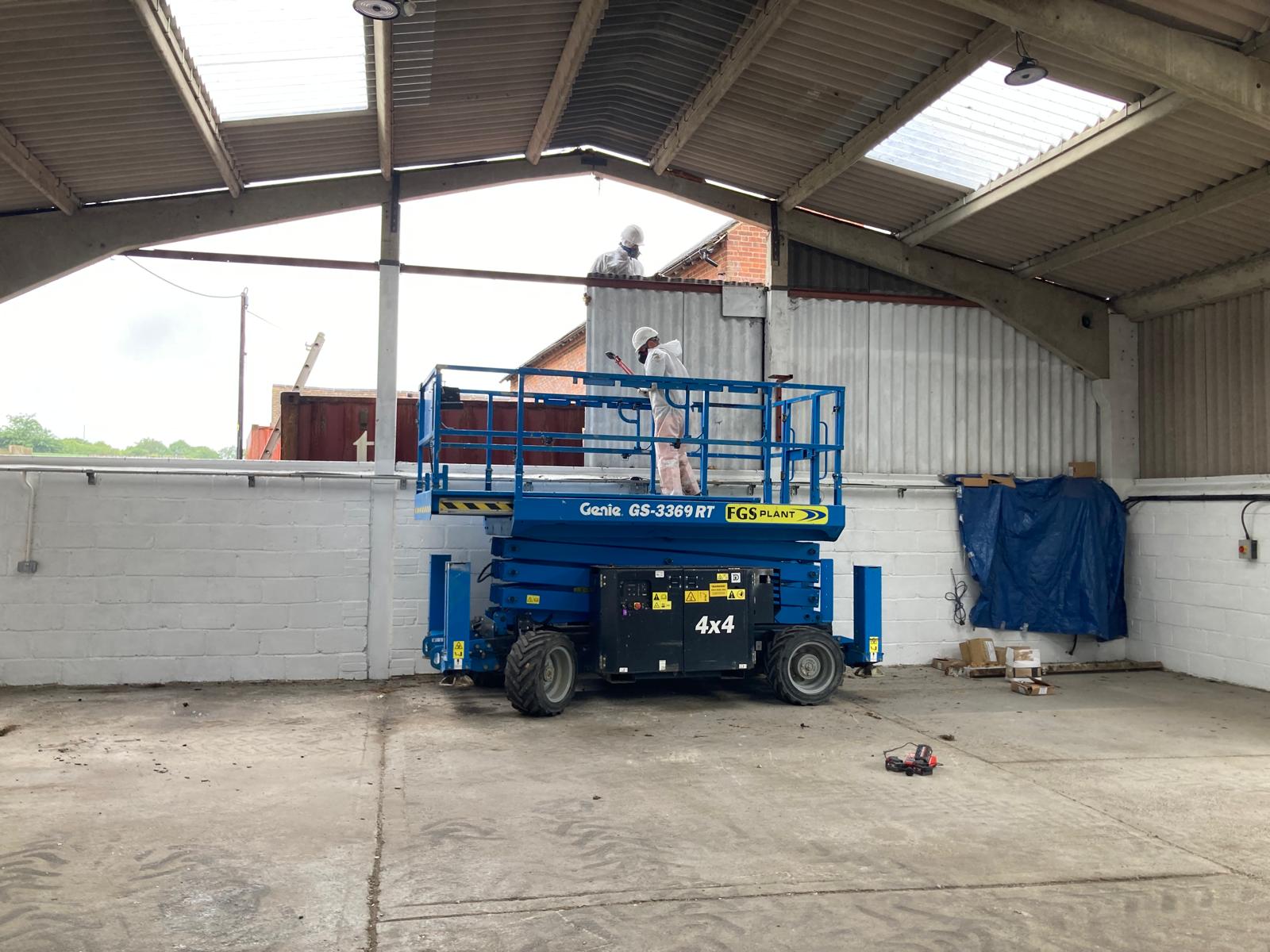
The classic grey corrugated sheets on industrial, agricultural and commercial buildings. Typically pre-2000 and contain 10–15% chrysotile (white asbestos) in a cement matrix.
Box gutters, eaves gutters and rainwater pipes made of the same cement-asbestos material as the sheets. Often the first part of the roof system to deteriorate.
Wall cladding, soffits and bargeboards on the same buildings — usually removed alongside the roof in a single co-ordinated programme.
Internal AIB ceiling panels, soffit boards and fire-protection boarding. Higher-risk material requiring sealed enclosure works.
Old GRP rooflights with asbestos-fibre reinforcement, plus EPDM/asbestos profile fillers at sheet laps and ridges.
Asbestos cement flues, roof vents and turbine ventilators — removed and replaced with modern equivalents.
We do not work with sprayed asbestos, asbestos lagging or asbestos rope (licensed Category 1 specialist works). For those we'll refer you to an appropriate contractor.
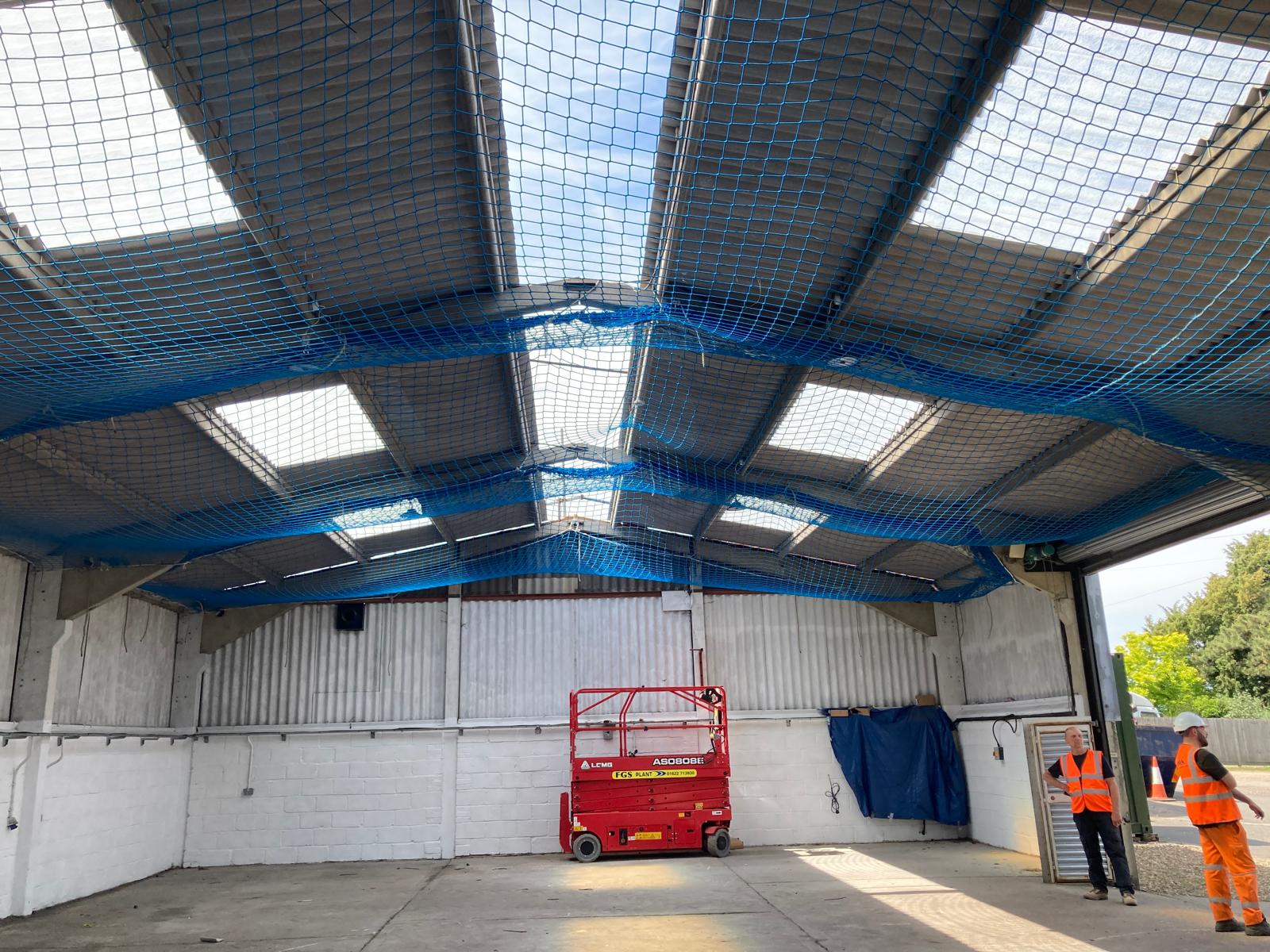
Asbestos cement sheets are fragile, and they get more fragile with age. HSE statistics record falls through fragile roofs as one of the most common causes of fatal injury in commercial roofing. Working on or near an asbestos roof without proper fall arrest isn't a corner that can be cut.
Every New-Cladd asbestos job includes:
The same documented process whether it's a single asbestos gutter on a unit in Tonbridge or a full asbestos roof strip on a 3,000 m² warehouse in Romford.
If you don't have a current refurbishment/demolition asbestos survey, we'll arrange one with an independent UKAS-accredited surveyor before works are quoted.
Risk assessments, method statements and the Plan of Work issued to the client and notified to HSE under ASB5 with a 14-day notice period.
Safety netting, decontamination units, signage, exclusion zones, MEWPs and skips brought to site. Pre-start meeting on site with client and CDM Principal Designer where applicable.
Asbestos sheets dampened to suppress fibre release, unfixed by hand (never broken), double-wrapped and labelled to UN3257. Operatives in full PPE; RPE face-fit tested on the day.
Sealed waste loaded into covered, locked transport and taken to a licensed hazardous-waste landfill. Consignment notes provided to the client for retention (statutory requirement).
Independent UKAS analyst attends, completes 4-stage clearance and issues a Certificate of Reoccupation. Client retains the certificate as evidence the area is safe.
The advantage of using a licensed roofing contractor (rather than a separate asbestos firm and a separate roofer) is that the asbestos strip and the new roof are part of the same project.
Strip Monday, new sheets going on by Wednesday. No two-week gap between contractors leaving the building open to the weather.
Quoted as a combined project. No expensive co-ordination fees or sub-contractor mark-ups bouncing between two firms.
Workmanship warranty on the asbestos strip plus full manufacturer-backed warranty on the new roof — from a single contractor.
Asbestos cement roof sheets are classed as non-licensed work under the Control of Asbestos Regulations 2012 — meaning in theory they don't require an HSE licence. In practice, all commercial roof works on asbestos require an HSE-notifiable Non-Licensed Work (NNLW) notification, properly trained operatives, RAMS, air monitoring and clearance. Using a contractor that handles asbestos cement strip routinely (like New-Cladd) gives you assurance the documentation, training and disposal are all to the higher standard.
Allow roughly 1 day per 100–150 m² of asbestos cement roof for the strip itself, plus 14 days of HSE notification before works can start. A typical 1,500 m² industrial roof would be a 10–14 day strip phase. We'll quote a binding programme alongside the price.
Costs are driven by sheet area, access (MEWPs vs scaffold), site conditions and waste tonnage. As an order-of-magnitude, expect £25–£45/m² for a straightforward industrial roof strip including disposal. Combined strip-and-replace is usually 30–40% cheaper than running the two as separate contracts.
We can advise — but anything beyond fixed roof and rainwater goods is normally outside the scope of a roofing contract. Where AIB ceilings, lagging or sprayed asbestos are involved we'll either refer you to a Cat-1 licensed specialist or co-ordinate one as part of a wider project.
On multi-let estates we issue tenant communication plans before works start. Asbestos cement strip works don't normally require neighbouring units to vacate, but exclusion zones around the building footprint will limit external access for the period of the strip phase. We'll plan it with you.
To a licensed hazardous-waste landfill, in sealed and labelled bags, transported in lockable covered vehicles, accompanied by a Hazardous Waste Consignment Note. You receive copies of all consignment notes for your records — legally retained for 3 years.