Kent's industrial stock from the 1970s and 80s leaves an awful lot of asbestos cement roofs still in place — on factory units, warehouses, farm buildings and the older trade-park estates. We strip them properly, dispose of them legally, and re-cover the building in one programme.
Kent had a particularly heavy run of light-industrial and warehouse build-out between roughly 1968 and 1984, when asbestos cement profiled sheet was the default roof covering for almost every steel-portal-frame building going up. The trade parks around Sittingbourne, the older industrial estates either side of the A20 through Maidstone, the units behind Ashford International and the back-of-Tonbridge yards off the A26 are all full of these roofs. Most are now well past their fifty-year service life. The sheets are weathered, cracked at the laps and shedding fibres — which is when removal stops being optional and becomes a legal duty under CAR 2012.
We run our Kent asbestos jobs out of a base inside the county, which matters in practice. The licensed waste-carrier paperwork, the consigning to a licensed Kent or East Sussex tip (Allington, Pepperhill or similar), the four-stage clearance certificate from an independent UKAS-accredited analyst — all of it has to chain together cleanly or the building owner is exposed. We've done this for forty years; we know which paperwork the HSE actually reads and which Kent landfills currently accept bonded asbestos cement.
Most of our Kent asbestos jobs are integrated — strip the cement sheet, replace with insulated composite or twin-skin built-up. Doing both in one programme saves the customer roughly 30% versus pulling two separate trades in, and it means the building isn't open to weather between phases. We've done it on factories in Aylesford, distribution units in Strood, dairy buildings out toward Marden and small workshop sites all the way down to the coast at Dover and Folkestone.
R&D surveys (formerly Type 3) carried out before any intrusive work on Kent industrial buildings — mandatory under CAR 2012 reg 5 before strip-out.
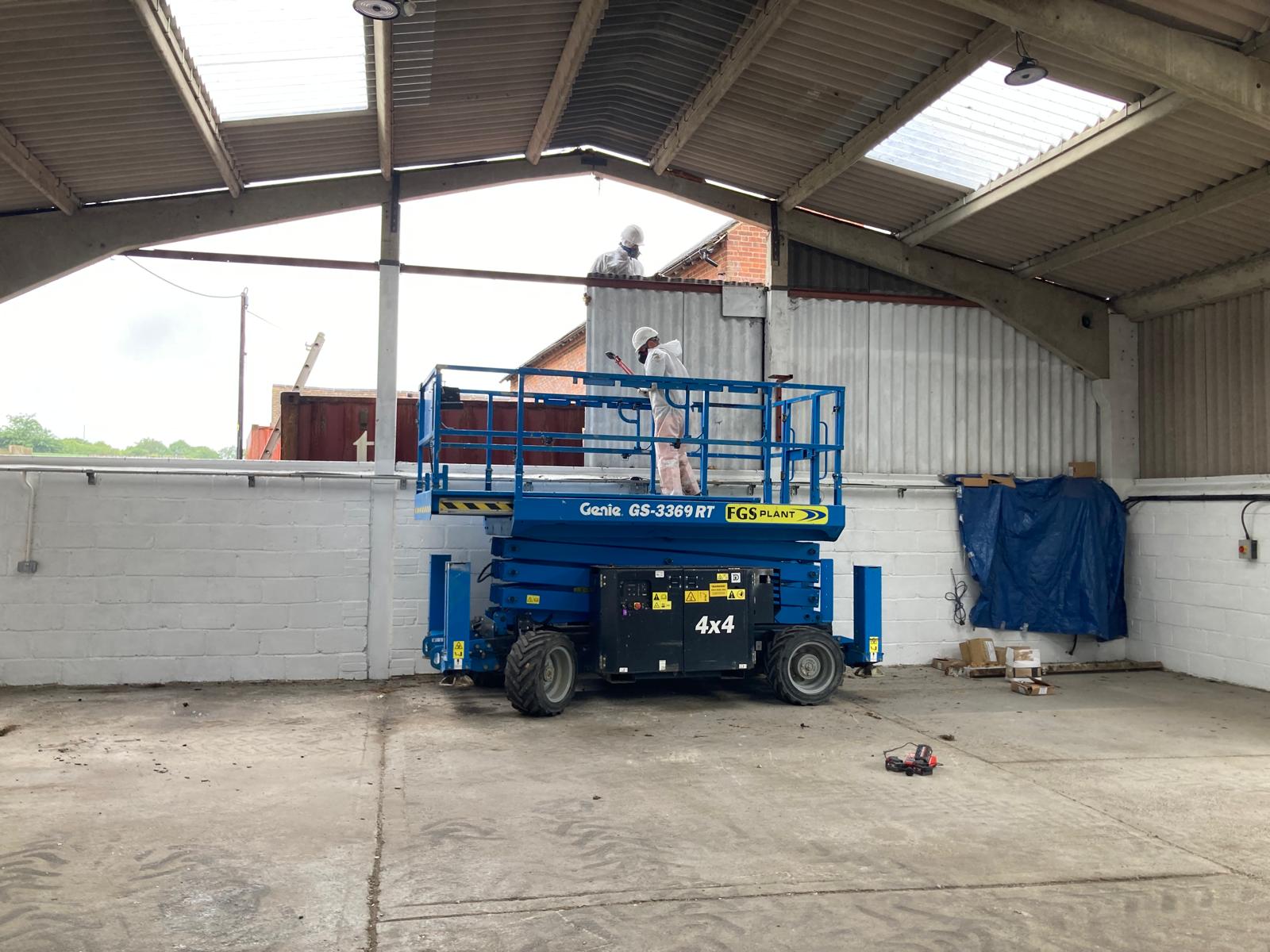
Bonded asbestos cement roof sheet removal — the typical Kent factory job, from the older Aylesford and Sittingbourne estates outward.
Where strip isn't viable yet, asbestos cement can be sealed and encapsulated to buy 10–15 years — useful for tenant-owned units pending a longer-term plan.
Sealed, wrapped, hazardous-waste consignment notes raised, disposed of at a Kent-licensed tip. Full paperwork chain handed to the building owner.
Independent UKAS-accredited analyst engaged for the four-stage clearance — we don't mark our own homework. Certificate of Reoccupation issued to you.
Once the asbestos is gone, same team re-clads the building in insulated composite, twin-skin built-up or PVDF-coated profile — one programme, one contract.
"We had two industrial units on the Sittingbourne side with original 1970s asbestos cement roofs — both leaking, both shedding fibres into the gutters. New-Cladd's surveyor flagged what was bonded vs. what wasn't, priced the strip, the disposal and the re-cover as one contract, and we were back trading inside four weeks. Paperwork was meticulous — HSE notification, consignment notes, four-stage clearance, the lot."
Asbestos cement roof sheet stripping is classed as Non-Licensed Work under the Control of Asbestos Regulations 2012. We notify every job to HSE under the ASB5 procedure, operate trained and face-fit-tested operatives in full RPE, track waste through the licensed-carrier consignment system, and arrange independent UKAS-accredited four-stage clearance. RAMS and certificates available on request.
All of Kent — ME (Maidstone, Sittingbourne, Chatham, Gillingham), CT (Canterbury, Ashford, Folkestone, Dover, Thanet), TN (Tonbridge, Tunbridge Wells, Cranbrook), BR (Bromley side) and DA (Dartford, Gravesend). For Sussex and Essex see our other service-area pages.
A standard 1,500–2,000 sq m industrial unit on a Kent trade park — survey, notify HSE (14-day notification period), strip, dispose, clearance — runs about 5–8 working days for the asbestos phase. Re-roofing on top of that is usually another 2–3 weeks depending on the spec.
The enclosed work area under the licensed strip must be empty and sealed off, yes — but on most Kent jobs we can phase the work so the rest of the unit keeps trading. We've kept distribution depots running through asbestos strips by isolating roof bays in sequence.
Bonded asbestos cement is double-wrapped, labelled, consigned under a hazardous-waste consignment note, and taken to a licensed tip currently accepting asbestos cement — usually one of the Kent or East Sussex facilities. We hand the consignment notes and the four-stage clearance certificate over as part of the project handover pack.