From the coastal trade parks of Brighton, Worthing and Chichester to the rural estates of the South Downs and the High Weald — commercial roofing built for what the Sussex weather actually does.
Sussex is two roofing problems in one county. Along the south coast strip — Brighton, Hove, Worthing, Shoreham, Eastbourne, Hastings and Bexhill — the challenge is salt-laden air, persistent damp and the sheer cumulative effect of fifty years of weather coming straight off the Channel. Standard PVF2-coated profiled sheet doesn't last as long here as it does inland. We routinely specify PVDF (Plastisol XRW or equivalent) coatings on coastal Sussex jobs because the standard spec won't see its warranty out.
Move 10 miles inland and the picture changes. Now we're on the Downs, in the Weald, around the listed estates between Lewes and Uckfield, or out on the agricultural belt heading toward Pulborough and Petworth. Here the roofs are usually older, the buildings are often part-rural part-commercial (a converted barn now used as offices; an equestrian arena that doubles as a wedding venue), and the planning constraints can be substantial. Standing-seam zinc, slate-effect coated steel and conservation-grade fibre cement become the dominant specifications.
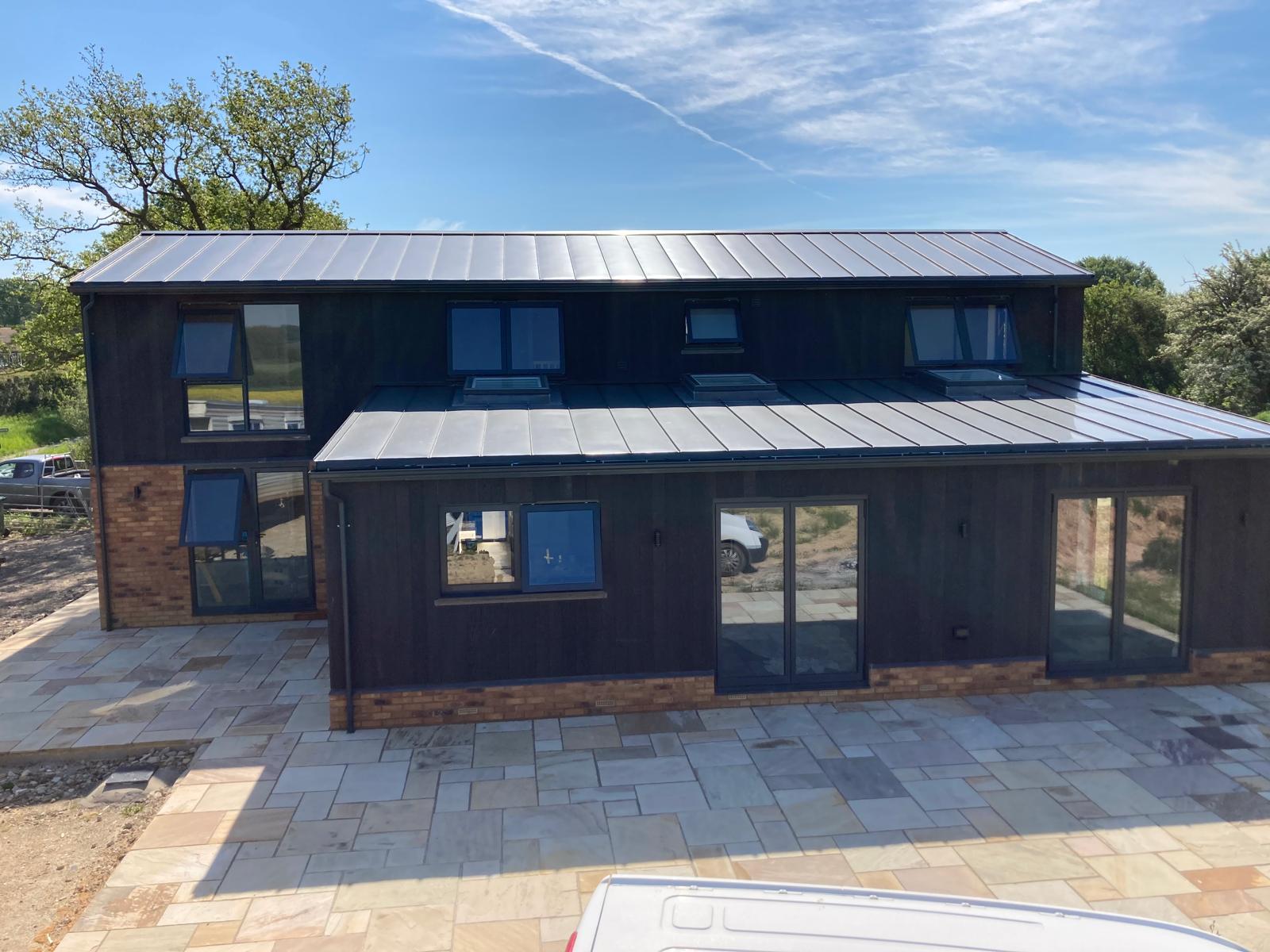
New-Cladd has spent 40 years on roofs in both halves of Sussex. We've replaced asbestos cement sheets on coastal industrial estates in Newhaven and Shoreham, fitted standing-seam dark-zinc envelopes on barn conversions outside Uckfield, and over-clad multi-let units on the Crawley and Burgess Hill trade parks. Same teams, different specs, identical standard of finish.
The trade-park and warehousing strip from Shoreham through Newhaven to Hastings — PVDF-coated systems specified for the salt-air environment.
Working farms across the Downs and the Weald, plus equestrian businesses around Lewes, Uckfield and the Horsham corridor. Agricultural roofing East Sussex →
Redundant agricultural buildings being converted to commercial, residential or holiday-let use. Standing-seam, slate-effect and zinc finishes.
Wedding venues, country-house hotels, event barns and visitor centres — aesthetic-driven specifications backed by commercial-grade construction.
Growing sector along the A23 corridor between Brighton and Crawley. Both new-build envelopes and re-roofs on acquired sites.
The Crawley, Burgess Hill, Worthing and Eastbourne trade-park economy — over-cladding, gutter renewal and rooflight replacement on aging multi-tenant estates.
"We needed a standing-seam zinc envelope on a barn conversion that planning had specifically signed off on a particular finish. Three contractors had tried to talk us into a cheaper coated-steel substitute. New-Cladd quoted the original spec, no debate, came in on price, and the finished roof is genuinely better than the architect's visuals."
All of BN (East and West Sussex coast), all of RH (mid-Sussex and the Crawley/Horsham corridor), and the Sussex portion of TN (Wadhurst, Crowborough, Battle, Rye). If you're in Surrey, we cover much of the southern half — call with your postcode.
For anything within roughly 5 miles of the south coast, we strongly recommend PVDF-coated (or Plastisol XRW) sheet rather than standard PVF2 or polyester. Both warranty length and real-world life are significantly better in marine-air environments. Budget difference is typically 10–15% on the roof sheets — well worth it on a 30-year asset.
Yes — we work on listed and curtilage-listed farm and estate buildings across the Weald and the Downs. We're familiar with the conservation-officer dialogue on roof sheet colour and profile, and we can specify slate-effect or natural-zinc finishes that typically pass without lengthy debate.
Yes for everywhere from Battle on the East coast through to Chichester in the west. Our Kent base means we add roughly 60–90 minutes' travel onto a Sussex job — rolled into the day, not charged separately.
For most commercial re-roofs no planning permission is needed (it's permitted development). Where it is, we'll provide the technical drawings and material specifications the planning officer needs. Conservation-area and listed-building consent enquiries: yes, we've been through it many times.